Table of Contents
- What Qualifies as Clean Beauty
- Clean Beauty vs Conventional Makeup Ingredients
- Clean Beauty Ingredients to Avoid
- How to Read Clean Beauty Labels
- Performance and Wear Time: Clean vs Conventional
- Safety, Preservation, and Shelf Life
- Environmental Impact and Sustainability
- Which Is Right for You: A Decision Framework
- Frequently Asked Questions
Last Updated: October 13, 2026
What Qualifies as Clean Beauty
Clean beauty is a consumer movement focused on transparency, ingredient safety, and excluding substances many shoppers consider harmful.
What qualifies as clean beauty typically means products formulated without parabens, phthalates, talc, synthetic fragrance, and certain preservatives. Many clean brands publish full ingredient lists, explain sourcing, and avoid synthetic chemicals where plant-derived alternatives exist.
At Gotcha Girl Cosmetics, our formulations exclude the controversial ingredients consumers worry about while maintaining performance and stability, so you know exactly what you're applying to your skin.
The movement has grown because conventional makeup manufacturing prioritizes cost efficiency and shelf stability over ingredient scrutiny. This doesn't make traditional makeup inherently unsafe, but fewer questions get asked about ingredient necessity or long-term skin impact.
Clean Beauty vs Conventional Makeup Ingredients
The ingredient differences between clean beauty and conventional makeup are substantial. Conventional makeup prioritizes performance, shelf stability, and cost. Clean beauty prioritizes ingredient safety, transparency, and skin compatibility, sometimes at the expense of formula complexity or price.
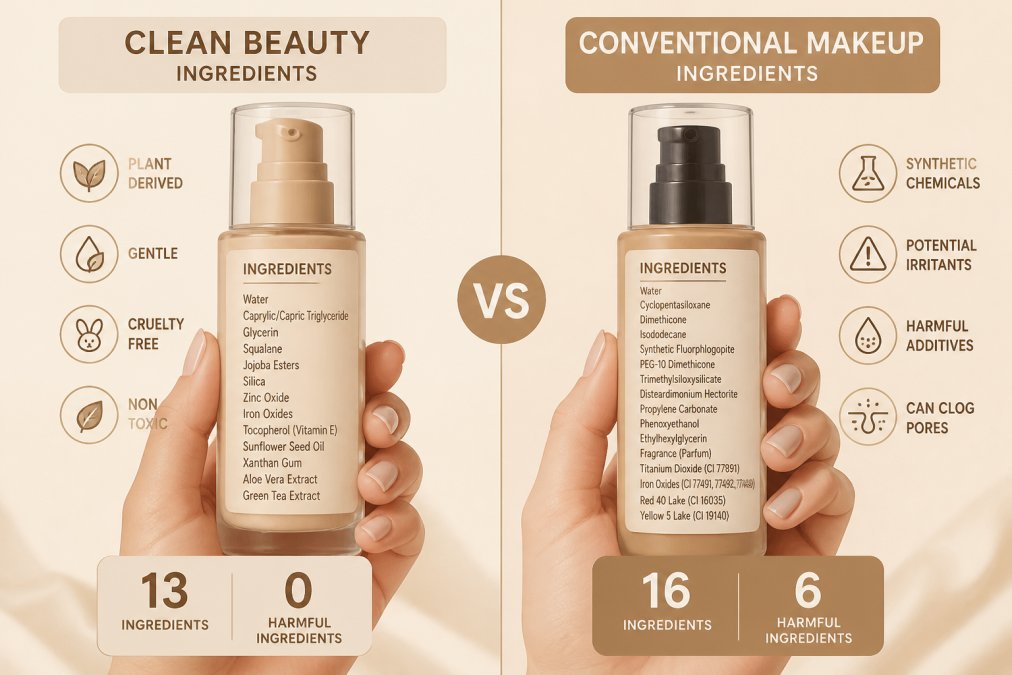
Conventional makeup often contains synthetic preservatives, silicones, talc, and fragrance compounds that perform well but raise concerns for sensitive skin. Clean formulas replace these with plant-derived preservatives, mineral powders, and essential oils, but may have shorter shelf lives or demand different application techniques.
Ingredient Transparency and Formulation Standards
Transparency is where clean and conventional makeup diverge most visibly. Clean brands publish complete ingredient lists, explain why each ingredient is included, and often provide sourcing information. Conventional brands list ingredients because law requires it, but rarely volunteer context.
Formulation standards differ too. Clean brands commit to exclusion lists, "formulated without" parabens, phthalates, or synthetic fragrance. Conventional brands have no such commitments, they use ingredients because they work, not because they've evaluated alternatives. This isn't negligence; it's a different business model.
The FDA requires ingredient labeling for all cosmetics but doesn't evaluate safety before products reach shelves, so both categories operate in the same regulatory environment (the FDA).
Synthetic vs Plant-Derived Components
Plant-derived ingredients dominate clean beauty marketing, but the synthetic-versus-natural distinction is less meaningful than marketing suggests. A lab-created synthetic ingredient can be safer and more stable than a plant extract, and plant-derived compounds can irritate sensitive skin.
Conventional makeup uses both synthetic and plant ingredients without preference; clean beauty favors plant-derived options when performance allows.
The performance gap has narrowed significantly: modern clean formulas deliver coverage, wear time, and finish comparable to conventional makeup. But they're not identical, a clean blush may blend differently, and a clean foundation might require a different primer. These are design choices, not flaws.
Clean Beauty Ingredients to Avoid
Understanding what clean beauty excludes helps you make informed choices. The most commonly avoided ingredients appear in conventional makeup because they're effective and inexpensive, not because they're universally dangerous.
Controversial Ingredients in Traditional Makeup
Parabens are preservatives that prevent microbial growth in water-based formulas. They're widely used in conventional cosmetics and approved by the FDA.
Phthalates are plasticizers used in conventional nail polish and fragrance compounds to improve flexibility and scent longevity.
Talc is a mineral powder used in conventional blush, eyeshadow, and foundation for texture and absorbency. Talc and asbestos can co-occur naturally, creating contamination risks (Using the geologic setting of talc deposits as an indicator of amphibole asbestos content).
Synthetic fragrance in conventional makeup can contain dozens of undisclosed compounds.
Silicones like dimethicone appear in conventional foundations and primers for smoothness and longevity. Clean brands avoid them because silicones don't biodegrade and may accumulate on skin.
These ingredients aren't banned by health agencies. They're excluded by clean brands because consumers want to avoid them, whether or not regulatory evidence supports the concern.
Why Formulation Matters for Skin Sensitivity
Sensitive and reactive skin responds differently to clean versus conventional formulas. Conventional makeup often contains multiple preservatives, fragrances, and emulsifiers that can trigger irritation. Clean formulas reduce these triggers by design.
If you have reactive skin, a clean formula doesn't guarantee compatibility, individual ingredients matter more than the "clean" label. But clean brands typically publish full ingredient lists and exclude common irritants, making it easier to identify triggers.
Conventional makeup isn't inherently harsh. Many people with sensitive skin use it without problems. The difference is that clean brands often anticipate sensitivity concerns and formulate accordingly. Conventional brands formulate for the average consumer, then note "for sensitive skin" as an afterthought.
How to Read Clean Beauty Labels
Reading labels effectively means understanding what language signals real differences versus marketing claims. Clean beauty labels often use specific terminology that communicates formulation choices.
"Formulated without" statements tell you exactly what the brand excluded, concrete and verifiable. "Clean ingredients" or "natural formula" are vague marketing terms without standard definitions.
Look for ingredient lists organized by concentration (highest to lowest) to see what actually dominates the formula.
Sourcing claims matter for environmental impact.
Certifications add credibility. Look for PETA certification (cruelty-free), leaping bunny logos, or third-party testing seals. These require verification and auditing. Marketing claims alone don't.
Compare ingredient lists side by side. A conventional foundation and a clean one might differ in five or six key components.
Performance and Wear Time: Clean vs Conventional
Performance is where many consumers discover that "clean" doesn't mean "worse." Modern clean formulas deliver coverage, longevity, and finish rivaling conventional makeup.
Demure Mineral Blush Powder – Bold Berry | Natural, Cruelty-Free →
Clean blush products like Gotcha Girl Cosmetics' Demure Mineral Blush Powder - Bold Berry demonstrate this shift.

Conventional makeup often performs exceptionally in specific conditions: a silicone-based foundation might apply more smoothly and last longer in humidity, and a mascara with synthetic polymers might hold a curl better. These differences matter for daily wear.
Clean makeup sometimes requires adjustment, a different primer, application technique, or blending method. A cream blush like Gotcha Girl Cosmetics' Sweet Cheeks Soft Cheek Tint applies with a doe-foot applicator and blends with fingertips for a naturally flushed finish.

The performance gap has genuinely narrowed. What matters now is finding products that match your skin type, climate, and application preferences, not assuming clean products underperform.
Safety, Preservation, and Shelf Life
Clean formulas face a real challenge: preserving products without synthetic preservatives while maintaining safety. This is where trade-offs become concrete.
Conventional makeup uses synthetic preservatives like parabens and phenoxyethanol because they're highly effective at preventing microbial contamination. They're inexpensive, stable across temperature ranges, and require minimal concentration.
Clean brands use plant-derived preservatives, natural antimicrobials, or minimal preservative systems.
This isn't a flaw in clean products, it's a design choice. If you store products carefully and use them within recommended timeframes, clean formulas are safe.
Shelf life varies widely within both categories. Some clean products last two years; others last six months.
Microbial contamination risk is real but manageable. Both clean and conventional products can harbor bacteria if contaminated during use.
Environmental Impact and Sustainability
Clean beauty marketing often emphasizes environmental benefits, but the reality is more nuanced.
Plant-derived ingredients require agricultural resources, water, land, and pesticides. Some clean brands source responsibly; others don't.
Packaging matters more than ingredient type. A clean product in plastic packaging has a larger footprint than a conventional product in recyclable or compostable packaging.
Gotcha Girl Cosmetics emphasizes both clean ingredients and sustainable sourcing.
Biodegradability is another consideration. Some clean ingredients break down naturally; others don't. Conventional silicones don't biodegrade and accumulate in waterways, while some clean plant oils biodegrade readily.
If environmental impact influences your choices, evaluate brands holistically: sourcing, manufacturing, packaging, and ingredient biodegradability. A "clean" label alone doesn't guarantee sustainability.
Which Is Right for You: A Decision Framework
Choosing between clean and conventional makeup depends on your priorities, skin type, and values. Neither category is universally better, they represent different trade-offs.
| Factor | Clean Beauty | Conventional Makeup | Consider This |
|---|---|---|---|
| Ingredient Transparency | Full disclosure standard | Listed but not explained | Clean wins if transparency matters to you |
| Skin Sensitivity | Often formulated to minimize irritants | May contain multiple potential triggers | Test both; sensitivity varies individually |
| Performance | Strong, but may require technique adjustment | Optimized for ease of use | Conventional may perform better in specific conditions |
| Shelf Life | Often shorter; may need careful storage | Typically longer; more forgiving | Conventional offers convenience advantage |
| Environmental Impact | Depends on sourcing and packaging | Depends on sourcing and packaging | Evaluate full lifecycle, not category alone |
| Price | Often higher due to sourcing standards | Typically lower | Clean carries sustainability premium |
| Ethical Sourcing | Commonly prioritized | Varies by brand | Clean brands more likely to publish sourcing details |
Start with your non-negotiables. If synthetic fragrance triggers migraines, clean beauty eliminates that concern.
Test products before committing to full routines. A clean blush might work beautifully while clean foundation doesn't suit your skin.
Consider your lifestyle. If you travel frequently and need products that tolerate temperature fluctuations without special storage, conventional makeup offers practical advantages.
Budget matters too. Clean beauty typically costs more due to sourcing standards and formulation complexity.
Gotcha Girl Cosmetics offers clean alternatives across price points. The Sweet Cheeks Soft Cheek Tint at $16.99 delivers clean, vegan, cruelty-free color at an accessible price. The SPF 50+ Foundation at $40.99 combines clean formulation with sun protection and full coverage, eliminating the need for separate products. The SupremeGlow CC Skin Perfector offers a hybrid approach, foundation, concealer, and skincare in one step.

Your choice doesn't need to be all-or-nothing.
The clean beauty movement reflects legitimate consumer concerns about ingredient safety, transparency, and environmental responsibility.
Frequently Asked Questions
What is the difference between clean beauty and conventional makeup?
Clean beauty prioritizes ingredient transparency and excludes synthetic fragrances, parabens, phthalates, and talc. Conventional makeup may contain these ingredients without restriction. Clean formulas emphasize natural or plant-derived components, though no universal regulatory definition exists. Conventional makeup focuses on performance and stability without the same ingredient restrictions. Both can be safe; the choice depends on your skin sensitivity and personal values around ingredient sourcing and formulation standards.
What clean beauty ingredients should you avoid?
Clean beauty standards typically exclude parabens, phthalates, talc, synthetic fragrance, silicones, and certain preservatives. However, 'clean' is not federally defined, so different brands exclude different ingredients. Common controversial ingredients include BHA and BHT (synthetic antioxidants), formaldehyde releasers (preservatives), and heavy metals. Read the ingredient list carefully and cross-reference with resources that track ingredient safety. Gotcha Girl Cosmetics products like the Demure Mineral Blush Powder contain 100% pure crushed minerals with no talc, fillers, or fragrance.
Is clean makeup safer than conventional makeup?
Safety depends on formulation and individual skin sensitivity, not the label alone. The FDA regulates both clean and conventional cosmetics under the same safety standards. Clean products may suit sensitive or reactive skin better because they exclude common irritants like synthetic fragrance and parabens. However, natural ingredients can also trigger allergies. Conventional makeup undergoes the same safety testing. The real difference is ingredient selection and transparency. If you have sensitive skin, patch test any new product regardless of whether it's labeled clean or conventional.
How can you tell if a makeup product is greenwashed?
Greenwashing happens when brands claim 'clean' or 'natural' without clear evidence. Check for vague terms like 'made with natural ingredients' without listing which ones, or brands using the word 'clean' without excluding specific controversial ingredients. Look for third-party certifications (cruelty-free, vegan, organic) rather than unverified marketing claims. Read the full ingredient list, not just the marketing copy. Compare what the brand excludes versus what it includes. Gotcha Girl Cosmetics lists exact ingredients and certifications, like the Sweet Cheeks Soft Cheek Tint being PETA-certified cruelty-free and 100% vegan.
Does clean makeup perform as well as conventional makeup in terms of coverage and wear time?
Performance varies by product, not by whether it's clean or conventional. Some clean formulas deliver full coverage and all-day wear; others prioritize lightweight feel over longevity. Conventional makeup has decades of synthetic ingredient development optimizing for durability and pigment payoff. Clean brands now match or exceed conventional performance through natural preservatives and plant-derived pigments. Check product reviews and wear-time claims for the specific item you're considering. Gotcha Girl's SPF 50+ Foundation offers full coverage and matte finish comparable to conventional options, while the Demure Mineral Blush provides buildable, water-resistant color.