Table of Contents
- Does a Glass Skin Routine Actually Work for Mature Skin?
- Why Mature Skin Needs a Different Glass Skin Approach
- The Korean Skin Care Routine for Mature Skin, Step by Step
- The Best Toner for Mature Skin: What to Look For
- A Glass Skin Routine for Dry Skin That Won't Flake
- How Long Does It Take to See Results From a Glass Skin Routine?
- Over-Exfoliation and Over-Layering: The Two Mistakes That Undo Your Glow
- Conclusion
- Frequently Asked Questions
Last Updated: October 19, 2026
Does a Glass Skin Routine Actually Work for Mature Skin?
Yes, a glass skin routine can work for mature skin, but not the way it works on a 22-year-old.
Here at Gotcha Girl Cosmetics, we hear this question constantly from women in their 30s, 40s, and 50s.
Glass skin is a beauty term for skin so hydrated and smooth it reflects light like a sheet of glass.
The short answer: mature skin can get dewy, radiant, and smooth. It just needs more hydration and less aggression.
What Glass Skin Really Means (and What It Doesn't)
Glass skin is not a filter, a fad, or a promise of poreless perfection. It's the look of skin that holds water well and reflects light evenly.
That means three things matter most:
- Hydration at every layer, not just the surface
- A healthy skin barrier that keeps moisture in
- Smooth texture so light bounces instead of scattering
What glass skin is not: a fix for deep wrinkles, a replacement for sunscreen, or a reason to buy twelve products. The American Academy of Dermatology's guidance on skin care keeps it simple: gentle cleansing, moisturizer, and sun protection do most of the work.
That's the frame to hold onto. Everything else is detail.
Why Mature Skin Needs a Different Glass Skin Approach
The biggest mistake with mature skin is copying a routine built for oily, resilient 20-something skin. Age-related skin changes shift the rules, and the shift is specific enough to plan around.
As skin matures, three things happen at once. Oil production drops, so there is less natural sebum to slow water loss. The stratum corneum, the outermost layer that acts as the barrier, holds less water and repairs more slowly.
That is why the mature-skin version of this routine flips the priorities:
- More hydration, fewer actives. Water-binding ingredients do the visible work; strong acids and retinoids are supporting players, not the headline.
- Gentle exfoliation once or twice a week, not nightly. Slower turnover does not mean you should scrub harder, it means you should exfoliate less aggressively and more consistently.
- Barrier support with soothing, moisture-retaining ingredients. A compromised barrier leaks water no matter how much you layer on top.
- Consistency over intensity. Skin that is cared for gently every day outshines skin that is treated aggressively twice a week.
Which Ingredients Actually Help Mature Skin
Not every "glow" ingredient is a fit. Here is how the common categories sort out for mature skin:
- Humectants, hyaluronic acid, glycerin, panthenol. These pull water into the upper layers and give the plump, dewy look glass skin is known for. They work best applied to damp skin and sealed with a moisturizer, or they can draw moisture back out in dry air.
- Barrier-supporting ingredients, ceramides, squalane, shea butter, snail mucin. These fill the gaps between skin cells and slow water loss. For mature skin, this is the step that makes hydration last past lunch.
- Niacinamide. Supports the barrier and helps even tone at concentrations most skin tolerates well. It layers cleanly with humectants.
- Gentle exfoliants, lactic acid, mandelic acid, low-strength PHA. These are larger-molecule acids that surface-exfoliate more slowly than glycolic acid, which makes them a better starting point for thinner, more reactive skin.
What to approach cautiously: high-percentage glycolic acid, daily acid toners, physical scrubs with rough particles, and any product that produces a strong sting or tingle. On mature skin, sensation is not a sign that something is working, it is usually a sign the barrier is being pushed.

A common mistake is layering five glow-enhancing products at once. That does not speed up results. It usually triggers sensitivity, and sensitive skin never looks dewy.
What Glass Skin Can and Cannot Do for Mature Skin
It helps to be clear about the ceiling. A glass skin routine can improve the appearance of plumpness, smoothness, and radiance, because hydrated skin reflects light more evenly and fine lines look less pronounced when the surface is not dehydrated. What it cannot do is erase wrinkles, permanently change pore size or texture, or create a literal glass-like finish. Those outcomes depend on genetics, sun history, and treatments beyond a topical routine.
The Korean Skin Care Routine for Mature Skin, Step by Step
This is the core routine. It is short on purpose. A Korean skin care routine for mature skin works best when each step has a job and nothing is stacked for the sake of it.
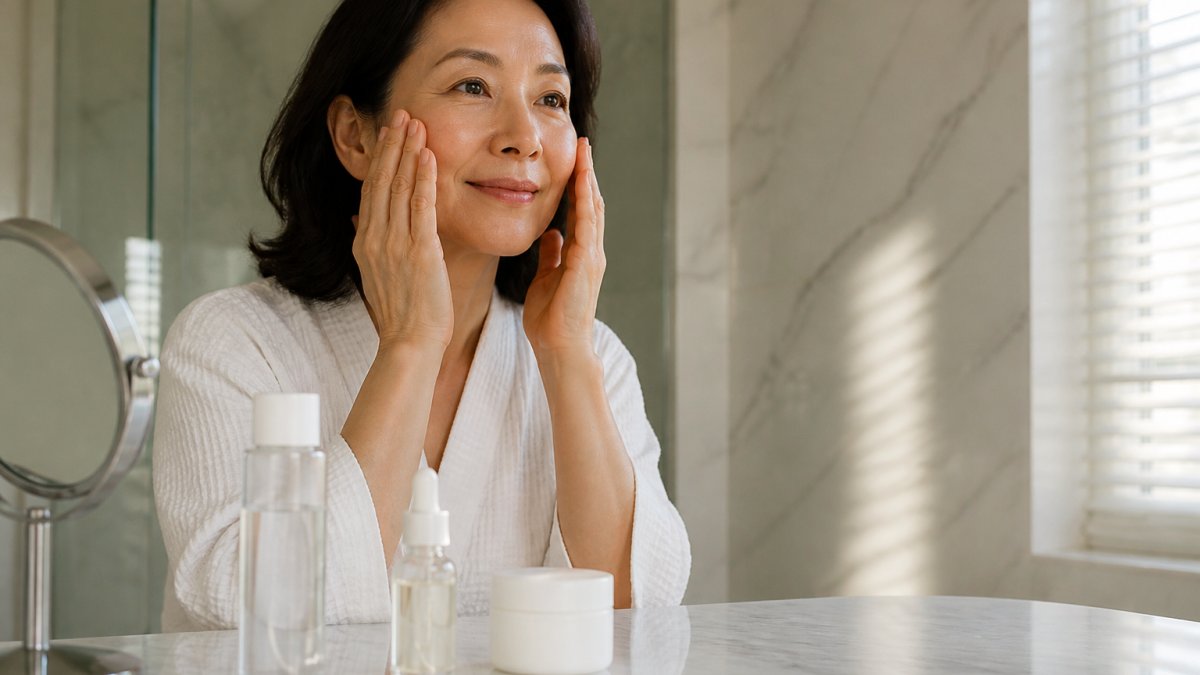
Step 1: Cleanse Gently (and Double Cleanse at Night)
Start with a hydrating cleanser that leaves skin comfortable, not tight. If it squeaks, it is too harsh.
At night, double cleansing helps if you wear makeup or sunscreen. Use a gentle oil-based cleanser first to dissolve sunscreen and makeup, then your regular cleanser.
Keep the water lukewarm. Hot water strips lipids from the barrier and makes the tight feeling worse.
Step 2: Tone, Then Layer Essence and Serum
After cleansing, apply a toner while skin is still slightly damp. Then press in an essence or hydrating serum.
Our HydraGlow™ Hyaluronic Acid Facial Essence fits this step well. It is a lightweight serum with hyaluronic acid and Vitamin C that absorbs fast and layers cleanly under moisturizer.
Pat, do not rub. Pressing products in helps absorption and avoids tugging mature skin.
Step 3: Seal It In With Moisturizer
Hydration means nothing if it evaporates. For mature skin, look for one with ceramides, squalane, or snail mucin rather than a lightweight gel alone.

Our Snail Mucin 97% Daily Face Moisturizer Cream is built for this.
Finish with sunscreen in the morning. Every time. Sun protection is the one step that protects the results of everything else in the routine.
Snail Mucin 97% Daily Face Moisturizer Cream, High Potency Moisturizing Cream →
Step 4: Exfoliate Once or Twice a Week, Not Nightly
This is the step mature skin most often gets wrong. Use a gentle leave-on exfoliant, lactic acid, mandelic acid, or a low-strength PHA, once or twice a week at night, after cleansing and before moisturizer.
Do not pair an acid with retinol on the same night. Alternate them, and give skin a plain hydration night between actives if it feels at all sensitive.
A Simple Weekly Rhythm
- Most nights: cleanse, tone, essence, moisturizer.
- One or two nights: swap in the gentle exfoliant before moisturizer.
- One or two nights (optional): retinol, buffered with moisturizer, if fine lines are a concern.
- Every morning: cleanse, tone, essence, moisturizer, sunscreen.
That is the whole routine. It is deliberately boring, and that is the point, the effect comes from suitable basics done consistently, not from a long lineup.
The Best Toner for Mature Skin: What to Look For
The best toner for mature skin is one that hydrates and soothes, not one that tightens or strips. Skip anything with a high alcohol content.
Look for:
- Hyaluronic acid or glycerin for moisture
- Panthenol or allantoin to calm skin
- Niacinamide for tone and barrier support
- No sting, no tingle, no tight feeling
Apply toner with your palms, not a cotton pad. Less waste, less friction, more hydration.
A Glass Skin Routine for Dry Skin That Won't Flake
A glass skin routine for dry skin needs one extra rule: layer thin, finish thick. Light watery products go first. Creams go last.
Here's the order that works:
- Hydrating cleanser
- Toner on damp skin
- Essence or hydrating serum
- Moisturizer to seal
- Sunscreen in the morning
If skin still flakes, add a hydrating mask once or twice a week. Our GlowDrench™ Bio Collagen Face Mask is an overnight option that delivers deep hydration and smooths texture while you sleep.

And if fine lines are your main concern, a retinol moisturizer used a few nights a week can help over time. Just don't pair it with strong acids on the same night.
How Long Does It Take to See Results From a Glass Skin Routine?
Most people see visible hydration and a softer texture within two to four weeks of consistent use. Full glow, the kind that reflects light evenly, usually takes eight to twelve weeks.
Here's the honest breakdown:
| Timeframe | What You'll Likely Notice |
|---|---|
| Week 1-2 | Skin feels softer, less tight after cleansing |
| Week 3-4 | Visible hydration, makeup sits smoother |
| Week 6-8 | Better texture, more radiance, fewer dry patches |
| Week 10-12 | Plumper skin, more even tone, real glow |
Consistency matters more than any single product. Skipping days resets the clock. And if you're using retinol, give it extra time, since results build slowly.
Over-Exfoliation and Over-Layering: The Two Mistakes That Undo Your Glow
Two habits undo more glass skin progress than anything else. Both come from impatience.
Over-exfoliation strips the barrier. Signs include stinging, redness, flaking, and a dull finish.
Over-layering means stacking too many actives at once: acid, then retinol, then vitamin C, then a peel.
A simple rule: if your skin stings when you apply moisturizer, your barrier needs a break, not another product.
Conclusion
A glass skin routine can absolutely work for mature skin. It just asks for patience and a lighter touch.
Gotcha Girl Cosmetics carries Korean-inspired skincare built for exactly this. Our ethically sourced, cruelty-free formulas are free from harsh chemicals and priced to fit a real budget.
Shop Gotcha Girl Cosmetics and give your skin the hydration it's been asking for.
Frequently Asked Questions
Does a glass skin routine work for mature skin?
Yes, but with adjustments. The core idea of a glass skin routine, layering hydration and sealing it in, suits mature skin well because moisture retention drops with age. What changes is the intensity: fewer exfoliating acids, gentler cleansing, and more barrier-supporting moisture. Expect a plump, dewy finish rather than poreless perfection. Fine lines soften when skin is hydrated, but a routine cannot erase them. Think of it as improving radiance and comfort, not reversing time.
Can mature skin use exfoliating acids in a glass skin routine?
Yes, in moderation. A glass skin routine for dry skin or mature skin should limit exfoliation to once or twice a week, and use one exfoliating product rather than stacking an acid toner, a peel, and a retinol on the same night. Over-exfoliation damages the skin barrier, which shows up as stinging, redness, and flaking, the opposite of a dewy finish. If your skin feels tight after cleansing or stings when you apply serum, cut back before adding anything new.
How long does it take to see results from a glass skin routine?
Visible hydration and a softer, more supple feel often show up within one to two weeks of consistent day and night use. Texture and tone changes usually take four to six weeks, since that is roughly how long skin takes to turn over. Fine lines look less pronounced as moisture levels rise, but that is a temporary plumping effect. Track progress with photos in the same lighting every two weeks rather than judging in the mirror daily.
What does toner actually do for mature skin?
A toner adds a first layer of hydration and helps prep skin so the steps after it absorb more evenly. For mature skin, the best toner for mature skin is one without drying alcohol, ideally with humectants like glycerin or hyaluronic acid. Apply it to slightly damp skin and press in with your palms rather than swiping with a cotton pad. That extra layer of moisture is what makes the following essence and serum sit better and keeps skin comfortable all day.