Table of Contents
- Why Sensitive, Reactive Skin Needs a Different Clean Beauty Approach
- Clean Beauty Ingredients to Avoid When Your Skin Reacts
- Ingredients That Calm and Repair a Compromised Skin Barrier
- How to Patch Test Skincare Before It Touches Your Face
- A Gentle Skincare Routine for Reactive Skin (Morning and Night)
- Environmental Triggers and Ingredient Conflicts That Undo Your Progress
- Conclusion: Building a Clean Beauty Routine Your Skin Can Trust
- Frequently Asked Questions
Last Updated: October 2, 2026
Why Sensitive, Reactive Skin Needs a Different Clean Beauty Approach
If your skin stings, flushes, or breaks out after a new "clean" product, you are not imagining it.
The word "clean" has no legal definition in the U.S. cosmetics market.
This guide from Gotcha Girl Cosmetics breaks down what calms reactive skin, what to avoid, and how to patch test before a product touches your cheeks.
Sensitive vs. Reactive Skin: What's the Difference?
Sensitive skin is a type you are born with: thinner, flushes easily, reacts to heat or stress.
Reactive skin is a state, not a type, your barrier is damaged and overreacting to things it once handled fine, often after over-exfoliating or layering too many actives.
Sensitive skin needs gentle, consistent care. Reactive skin needs a repair phase first, then maintenance.
The Psychological Toll of Chronic Reactivity
Chronic redness or stinging wears you down, many people avoid photos, social events, even mirrors. Stress raises cortisol, which slows barrier repair and triggers more flushing, feeding the cycle. A short, predictable routine does more for reactive skin than a ten-step one.
Clean Beauty Ingredients to Avoid When Your Skin Reacts
Certain ingredients cause most reactions in reactive skin. Dermatology and cosmetic chemistry point to four categories, fragrance, essential oils, drying alcohols, and harsh preservatives, each stripping the barrier or triggering inflammation differently. Cutting all four at once works faster than cutting one at a time. Here is what to cut first:
- Fragrance and parfum, whether natural or synthetic, fragrance is a known contact allergen. It does not damage the barrier directly; it triggers an immune response in skin that is already primed to overreact. On an INCI label, look for "fragrance," "parfum," and any individual scent compound listed separately.
- Essential oils, citrus (limonene, citral), lavender (linalool), and peppermint (menthol) are concentrated plant compounds. Many are natural fragrance allergens under cosmetic labeling rules, and menthol in particular produces a cooling sensation that reactive skin reads as irritation.
- Drying alcohols, denatured alcohol, SD alcohol, isopropyl alcohol, and ethanol. These evaporate quickly and take skin lipids with them, which is why they give a light, fast-drying feel. If any of these appear in the first five ingredients, the formula is likely too stripping for a compromised barrier.
- Harsh preservatives, formaldehyde releasers such as DMDM hydantoin, diazolidinyl urea, and quaternium-15. These are legal and effective preservatives, but they are among the more common sensitizers. Gentler systems include phenoxyethanol, sodium benzoate, and potassium sorbate.
- Physical scrubs, walnut shell powder, apricot kernel powder, and sugar or salt crystals create micro-tears in a barrier that is already thin. Chemical exfoliation is not automatically safer for reactive skin, but physical scrubs are the more predictable irritant.
Fragrance, Essential Oils, and Drying Alcohols
Fragrance is the leading cause of allergic contact dermatitis in skincare, and "natural" fragrance is not safer, the same allergens appear in both. Essential oils are concentrated plant chemistry that can burn reactive skin.
Drying alcohols feel elegant and help actives absorb, but on a barrier already leaking water, they accelerate the leak. If alcohol denat. or SD alcohol is in the top five ingredients, skip it until your barrier recovers.
Harsh Preservatives and Exfoliating Acids
Some preservatives release small amounts of formaldehyde over the product's life, a repeated low-grade exposure that can keep a reactive barrier inflamed even when everything else is clean.
Exfoliating acids, glycolic, lactic, salicylic, mandelic, are useful for texture and congestion but are the most common self-inflicted cause of reactive skin.
Pause all exfoliating acids until your skin goes two full weeks without stinging, flushing, or new bumps.
How to Read a Label in Under a Minute
You do not need to memorize every chemical name, just use a fast filter:
- Scan the first five ingredients. If alcohol denat., SD alcohol, or fragrance appears there, put it down.
- Search the full list for "parfum," "fragrance," "limonene," "linalool," "citral," and "menthol." Any one is a flag for reactive skin.
- Check for formaldehyde releasers: DMDM hydantoin, diazolidinyl urea, imidazolidinyl urea, quaternium-15.
- Treat "cooling," "tingling," or "warming" claims as a warning, not a feature.
This filter takes about a minute per product and eliminates most formulas that will set your barrier back.
Ingredients That Calm and Repair a Compromised Skin Barrier
The right ingredients do two jobs: calm inflammation and rebuild the barrier. Humectants pull water in, ceramides seal it, and soothing agents reduce redness while repair happens. Key ingredients to look for:
- Ceramides to rebuild the barrier
- Hyaluronic acid to hold water in the skin
- Panthenol (provitamin B5) to soothe
- Centella asiatica to calm redness
- Allantoin to soften and protect
Ceramides, Hyaluronic Acid, and Panthenol
Ceramides are the fats that make up your skin barrier. When they are low, water escapes and irritants get in; replacing them is a core repair step.

Hyaluronic acid draws moisture in and reduces transepidermal water loss (pubmed.ncbi.nlm.nih.gov). Panthenol calms irritation and supports healing, gentle enough for daily use on reactive skin.
A lightweight option is the HydraGlow™ Hyaluronic Acid Facial Essence at $24.99. It pairs hyaluronic acid with Vitamin C and plant extracts to hydrate without a greasy feel.
Centella Asiatica and Allantoin for Redness Reduction
Centella asiatica, or cica, is a plant extract that calms red, angry skin, a Korean skincare staple. Allantoin softens skin, helps it hold moisture, and supports natural repair. Together they reduce visible redness and tightness.
How to Patch Test Skincare Before It Touches Your Face
Patch testing is the single most important step for reactive skin, it catches a bad reaction before it hits your whole face. Most people skip it, then blame the product. Here is how to do it right:
- Clean a small area on your inner forearm or behind your ear.
- Apply a pea-sized amount of the product.
- Wait 24 hours and check for redness, itching, or bumps.
- If clear, apply again and wait another 24 hours.
- If still clear, test on a small patch of your jawline.
- Wait 24 more hours before using it on your full face.
Test one new product at a time. If you test three at once and react, you will not know which one caused it.
HydraGlow™ Hyaluronic Acid Facial Essence – Deep Moisture Korean Skin Serum →
A Gentle Skincare Routine for Reactive Skin (Morning and Night)
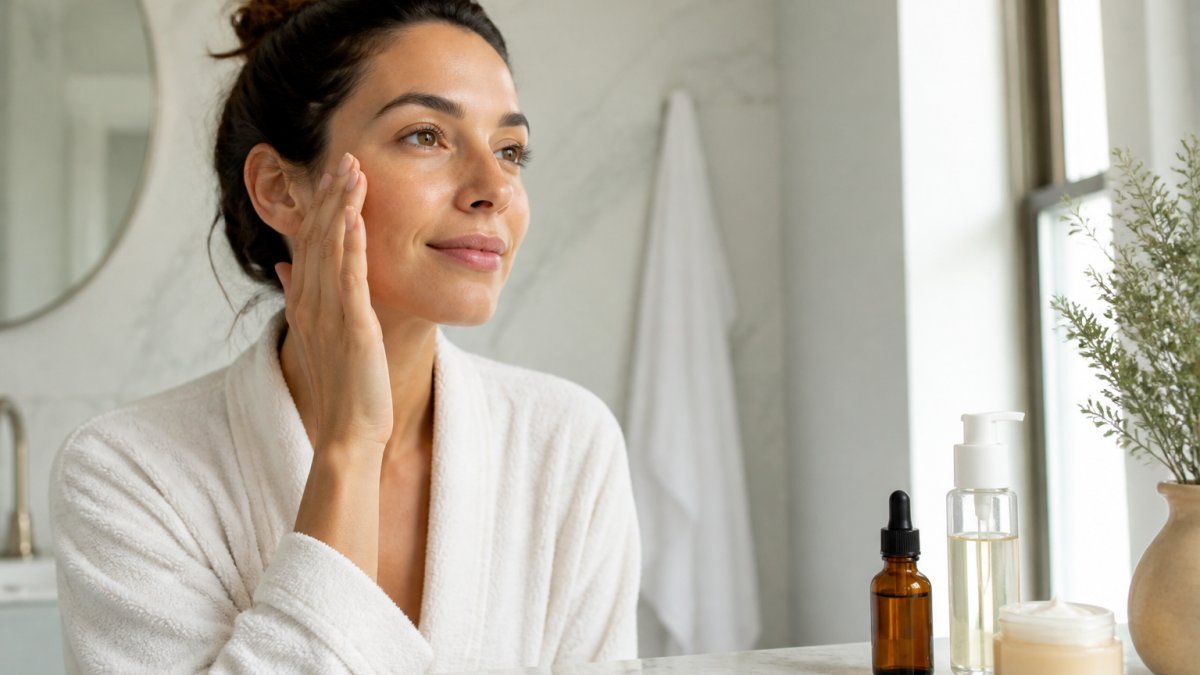
A reactive skin routine should be short and boring: fewer steps, fewer chances for irritation, and fewer variables to identify when something goes wrong. The goal is simple, cleanse gently, hydrate, repair, protect.
How Many Steps Is Too Many
For reactive skin, three to four steps per routine is the practical ceiling. People who develop reactivity often ran seven to ten steps, layered multiple actives, and added new products weekly, the skin failed from total load, not one bad product.
A workable rule: one cleanser, one hydrating layer, one moisturizer, one sunscreen in the morning; swap sunscreen for a barrier cream or occlusive at night. Everything else is optional, added only after two weeks of stability.
Morning: Cleanse, Hydrate, Protect
If your skin is very dry or reactive, rinse with water only in the morning and save the cleanser for evening.
Step 2, Hydrate. Apply a hydrating serum or essence to damp skin, it absorbs humectants better and loses less water.
Step 3, Moisturize. Lock hydration in with ceramides, cholesterol, or fatty acids, the lipids the barrier is built from.
Step 4, Protect. Sunscreen every day, even indoors near windows, even in winter.
A fragrance-free, non-comedogenic option is the Aveeno Sheer Hydration Daily Moisturizing Lotion at $16.99. It uses prebiotic oat and is free of fragrance, parabens, and dyes.

Evening: Remove, Repair, Lock in Moisture
Step 1, Remove. Take off makeup and sunscreen with a gentle cleanser or micellar water.
Step 2, Hydrate. Same hydrating serum as the morning, on damp skin.
Step 3, Repair. Apply a barrier cream with ceramides, cholesterol, and fatty acids.
Step 4, Seal. If very reactive or dry, finish with a thin layer of plain occlusive balm, petrolatum, squalane, or shea, on the driest areas.
A Simple Routine Map
| Step | Morning | Evening | Key Ingredient |
|---|---|---|---|
| Cleanse | Gentle cream or low-foam cleanser | Cleanser (or oil balm + cleanser) | Fragrance-free surfactants |
| Hydrate | Hyaluronic serum on damp skin | Hyaluronic serum on damp skin | Hyaluronic acid, glycerin |
| Repair | Light moisturizer | Barrier cream | Ceramides, cholesterol, fatty acids |
| Protect | Mineral or fragrance-free sunscreen | Occlusive balm on dry spots | Zinc oxide, petrolatum, squalane |
What to Do When Your Skin Still Reacts
If your skin reacts even on a minimal routine, one product inside it is usually the culprit. Strip back to cleanser, moisturizer, and sunscreen only for seven to ten days. Once calm, reintroduce one product at a time, at least four days apart, to identify the trigger.
Environmental Triggers and Ingredient Conflicts That Undo Your Progress
Your routine can be perfect and still fail if your environment works against it. Common triggers beyond your shelf:
- UV exposure that damages the barrier
- Hard water that leaves residue and strips oils
- Dry indoor air from heating or AC
- Pollution that causes oxidative stress
- Hot showers that strip natural oils
Ingredient conflicts matter too. Mixing vitamin C with strong acids, or retinol with exfoliants, can overload reactive skin. When in doubt, use one active at a time.
Conclusion: Building a Clean Beauty Routine Your Skin Can Trust
Reactive skin does not need more products, it needs fewer, better ones. Cut the irritants, add barrier-repair ingredients, patch test everything, and keep your routine short.
Gotcha Girl Cosmetics carries clean, cruelty-free options built for exactly this. The Demure Mineral Blush Powder at $34.99 is talc-free and fragrance-free, and the Sweet Cheeks Soft Cheek Tint at $16.99 is a vegan, buildable cream blush that works on sensitive skin.

Shop Gotcha Girl Cosmetics and build a routine your skin can actually trust.
Frequently Asked Questions
What ingredients should sensitive, reactive skin avoid in clean beauty products?
Reactive skin does best without synthetic fragrance, essential oils like citrus or lavender, drying alcohols (denatured alcohol, SD alcohol), and harsh preservatives such as methylisothiazolinone. Physical exfoliants and high-percentage acids can also trigger flare-ups. Look for fragrance-free, hypoallergenic, non-comedogenic formulas instead. Clean beauty for sensitive reactive skin means reading the full ingredient list, not just trusting a 'natural' label, because botanical extracts can irritate too.
How do I patch test new skincare safely if my skin is reactive?
Apply a small amount of the product to a quarter-sized area behind your ear or on your inner forearm. Leave it uncovered for 24 hours without washing it off. If no redness, itching, or bumps appear, repeat on a small patch of your jawline for another 24 hours. Only then introduce it to your full face. Keep a photo log so you can track delayed reactions, which can show up 48 to 72 hours later with reactive skin.
Can clean beauty products actually reduce redness and irritation?
Yes, when they contain barrier-supporting ingredients. Ceramides, hyaluronic acid, panthenol, centella asiatica, and allantoin help calm inflammation and support skin barrier repair. A fragrance-free, pH-balanced formula with these soothing agents can visibly reduce redness over several weeks. Pair it with a gentle cleanser and a moisturizer that locks in moisture to limit transepidermal water loss. Avoid layering too many active ingredients at once.
What is the difference between sensitive and reactive skin?
Sensitive skin is a skin type you are born with, often fair, thin, and prone to redness. Reactive skin is a condition where your skin reacts to specific triggers like fragrance, preservatives, or environmental stressors with stinging, burning, or breakouts. You can have reactive skin without being naturally sensitive. That distinction matters because reactive skin benefits most from an irritant-free routine and patch testing every new product before full application.