Table of Contents
- What Makes a Clean Beauty Retailer Trustworthy
- How to Read Skincare Labels for Toxins
- Best Clean Beauty Online Stores for Korean Skincare
- Korean Skincare Ingredient Safety Standards
- Sokoglam Alternatives for Clean Beauty Products
- Price Comparison and Value
- Building a Clean Skincare Routine
- Frequently Asked Questions
Last Updated: September 23, 2026
What Makes a Clean Beauty Retailer Trustworthy
A trustworthy clean beauty retailer provides verifiable ingredient transparency, third-party certifications, and clear return policies that protect customers experiencing sensitivity reactions. Knowing what to look for requires understanding where and how to verify claims independently.
Verifying Certifications and Claims
When a brand claims "clean," "natural," or "organic," verify it independently through third-party databases.
Cruelty-Free Certifications: Search the official Leaping Bunny database at leapingbunny.org to verify certification status, testing methods, and parent company ownership.
Organic Certifications: The USDA Organic seal verifies certified organic ingredients. Cross-reference any product's certification number on the USDA Organic Integrity Database (organic.ams.usda.gov).
Clean Beauty Standards: No federal definition of "clean beauty" exists, so brands use the term freely. However, some retailers adopt third-party standards like the Clean Beauty Pledge, which requires ingredient disclosure and avoidance of specific chemicals.
Dermatologist Testing: "Dermatologist-tested" means evaluation occurred but doesn't guarantee safety or efficacy. The FDA doesn't regulate this claim. Ask retailers for testing protocols or studies; reputable brands provide them upon request.
Red Flags in Retailer Transparency
Avoid retailers that hide ingredient sourcing, refuse patch-testing guidance, use vague ingredient percentages like "infused with" instead of exact concentrations, or lack accessible return policies.
Building Your Verification Checklist
Before buying from a new retailer:
- Search the brand on Leaping Bunny (leapingbunny.org) or PETA's database (peta.org/cruelty-free).
- Check the USDA Organic Integrity Database for organic certification numbers.
- Visit the retailer's website for sourcing or transparency pages; email customer service if absent.
- Review return policies.
- Look for third-party certification logos with verification links.
Retailers that make verification easy, providing certification numbers, sourcing details, and testing protocols, prioritize customer education and ingredient safety.
How to Read Skincare Labels for Toxins
Ingredients are listed by concentration. Look for "fragrance-free" or products scented with essential oils or plant extracts.
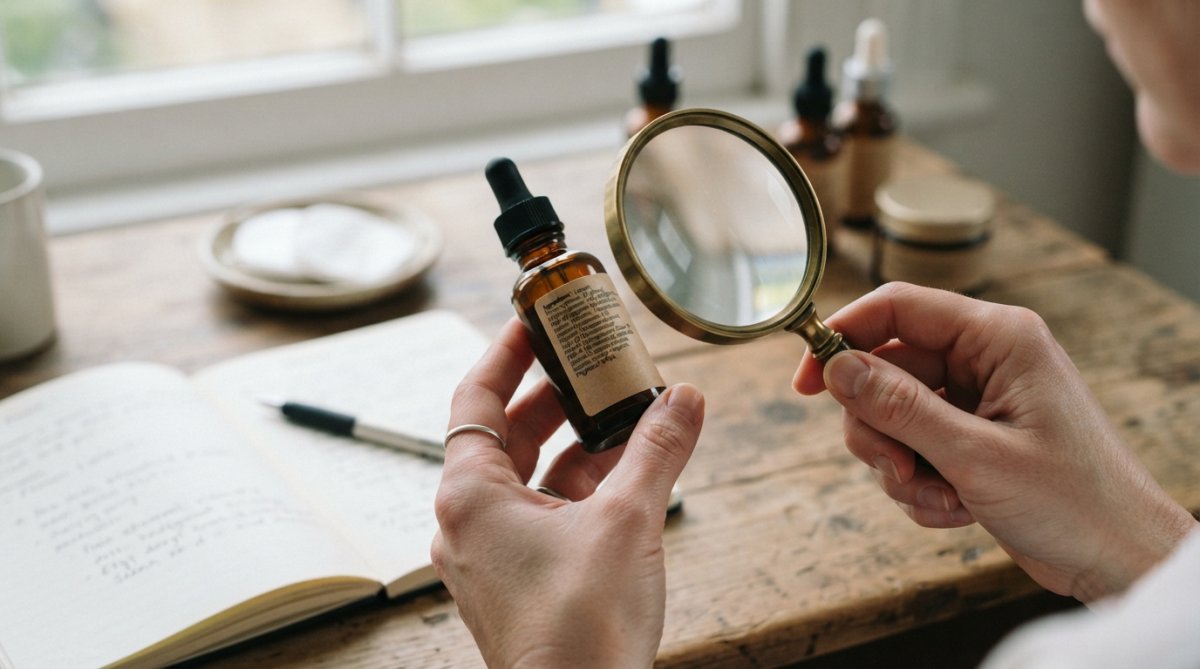
Transparency means the label tells you what's NOT inside. Phrases like "paraben-free," "sulfate-free," and "phthalate-free" signal avoidance of problematic substances.
| Ingredient Type | What to Avoid | What to Look For |
|---|---|---|
| Preservatives | Parabens, formaldehyde releasers | Phenoxyethanol, sodium benzoate, potassium sorbate |
| Cleansing agents | Sulfates (SLS, SLES) | Amino acid-based, plant-derived cleansers |
| Fragrance | Synthetic fragrance, phthalates | Essential oils, plant extracts, fragrance-free |
| Moisturizers | Mineral oil, petrolatum | Hyaluronic acid, glycerin, plant oils |
| Active ingredients | Synthetic retinoids (if sensitive) | Bakuchiol, retinol alternatives, niacinamide |
Best Clean Beauty Online Stores for Korean Skincare
Korean skincare emphasizes hydration-first routines, pH-balanced formulas, and ingredient-driven solutions focused on prevention and skin barrier health. Gotcha Girl Cosmetics carries essences, serums, and moisturizers designed for complete Korean skincare routines.

The HydraGlow™ Hyaluronic Acid Facial Essence ($24.99) delivers deep hydration with Vitamin C and botanical extracts. For barrier repair, the Snail Mucin 97% Daily Face Moisturizer Cream ($42.99) combines high-concentration snail mucin with dermatologist-tested, cruelty-free ingredients. Snail mucin calms irritation and supports skin healing while absorbing quickly without residue.

Korean mask treatments offer intensive hydration. The DermaGlow™ 5PC Korean Collagen Peel-Off Mask ($98.70) uses hydrolyzed collagen to lift and firm, while the GlowDrench™ Bio Collagen Face Mask ($29.85) works overnight to plump skin and shrink pores.
Korean Skincare Ingredient Safety Standards
Reputable retailers source products that passed these checks.
Common Korean skincare actives prioritize safety and efficacy: niacinamide brightens without irritation, hyaluronic acid hydrates at multiple molecular weights, and bakuchiol offers retinol-like benefits without sensitivity. Tranexamic acid is another Korean innovation, reducing dark spots and pigmentation. The GlowFade™ TX Tranexamic Acid Cream ($257.90) targets discoloration while supporting skin healing across all skin types.

Patch testing remains essential even with clean formulas. Apply a small amount behind your ear or inner arm, wait 24-48 hours, then introduce slowly into your routine.
Sokoglam Alternatives for Clean Beauty Products
If exploring sokoglam alternatives for clean beauty, consider what matters most: ingredient transparency, pricing, shipping speed, or product range. Gotcha Girl Cosmetics combines Korean skincare innovation with transparent sourcing, affordable pricing, and verified cruelty-free status, prioritizing education about why each ingredient matters.
Serums and Essences for Hydration
Essences and serums deliver active ingredients directly to skin and prepare it to absorb heavier moisturizers. The HydraGlow™ Hyaluronic Acid Facial Essence hydrates across multiple skin layers with vitamin C and botanical extracts at $24.99. Essences are lighter and applied immediately after cleansing; serums are more concentrated and applied after essences.
When choosing hydrating essences, look for hyaluronic acid concentration and supporting botanicals.
Moisturizers and Barrier-Repair Creams
A strong skin barrier is foundational for clear, healthy skin. The Snail Mucin 97% Daily Face Moisturizer Cream combines hydration with barrier support through glycoproteins and hyaluronic acid. For mature skin, the Collagen Face Mask 5 Pack ($44.99) provides intensive overnight repair, plumping fine lines and improving elasticity when used 2-3 times weekly. The Tallow Honey Balm™ ($47.88) offers ingredient simplicity with organic grass-fed beef tallow and raw honey, ideal for very dry or compromised barriers.
Masks and Treatment Products
Weekly masks prevent dead skin cell buildup and dehydration. The DermaGlow™ 5PC Korean Collagen Peel-Off Mask removes impurities while delivering collagen. The 24K Gold Bio Collagen Face Mask ($34.99) combines hydration with anti-aging benefits; use 1-2 times weekly. Overnight masks like GlowDrench™ Bio Collagen Face Mask ($29.85) lock in hydration and actives while you sleep.
HydraGlow™ Hyaluronic Acid Facial →
Foundation and Makeup
The Natural Coverage Mesh Tight Up Cushion ($54.99) delivers Korean beauty's signature dewy finish with lightweight, hydrating, buildable coverage. The Demure Mineral Blush in Bold Berry ($34.99) uses 100% pure crushed minerals with no talc or synthetic fragrance, working well for sensitive skin.
Price Comparison and Value
Price-per-ounce matters as much as sticker price. Gotcha Girl Cosmetics ranges from $24.99 for the HydraGlow™ Essence to $257.90 for the GlowFade™ TX Tranexamic Acid Cream, reflecting product type and concentration. A complete routine might include essence ($24.99), moisturizer ($42.99), weekly mask ($29.85), and targeted treatment ($34.99-$257.90), approximately $132-$355 monthly.
Building a Clean Skincare Routine
A complete routine follows this order: cleanse, tone, essence, serum, moisturizer, treatment, sunscreen (morning). A strategic transition identifies which products work for your skin.
Understanding Skin Purging vs. Sensitivity Reaction
Purging is temporary increased breakouts (small whiteheads in usual problem areas) lasting 2-4 weeks as active ingredients speed cell turnover. Sensitivity reactions include immediate redness, burning, itching, hives, or swelling that worsen over time. Sensitivity reactions require stopping the product immediately; purging typically improves with continued use.
The 2-Week Transition Protocol
Week 1: Replace your cleanser and use for 7 days while keeping other products unchanged.
Week 2-3: Introduce a clean-beauty moisturizer. If skin feels tight or irritated, you may need a richer formula or additional hydrating layer.
Week 4-5: Add hydrating essence or serum every other day first, then daily. Watch for purging (small breakouts in congestion-prone areas) versus sensitivity (redness, burning, swelling).
Week 6+: Add targeted treatments like masks or serums with actives, again introducing every other day first.
Sunscreen (morning): Add SPF 30+ after moisturizer as the final morning step, non-negotiable when using active ingredients.
Identifying Problem Products During Transition
Track your skin's response by noting the date introduced, product name and ingredient focus, skin response (purging, sensitivity, no change, or improvement), and duration. Common sensitivity triggers include essential oils, high-concentration actives, specific plant extracts, and preservatives. Once identified, avoid these ingredients in future products.
The 30-Day Stabilization Period
After introducing all core products, give skin 30 days to stabilize before adding more. Assess whether skin is clearer, more hydrated, or less irritated; whether purging has resolved; and whether additional products are needed. Stick with your routine for 30-60 days before making changes.
Budget-Friendly Transition Strategy
Start with essentials:
- Gentle cleanser ($15-$30)
- Hydrating essence or serum ($20-$40)
- Moisturizer ($30-$50)
- Sunscreen ($15-$25)
Total starter investment: $80-$145 for 2-3 months. Add targeted treatments after stabilization based on specific skin needs.
Beginners Often Make These Mistakes
Buying too many products at once: If your skin reacts, you won't know which product caused it.
Expecting immediate results:
Ignoring purging: Small breakouts in usual problem areas for 2-3 weeks after introducing active ingredients is likely purging. If breakouts worsen or spread after 4 weeks, stop and reassess.
Skipping sunscreen: Without SPF 30+, you risk sun damage and hyperpigmentation.
Not patch-testing: Test new products on your inner arm or behind your ear for 24-48 hours before full-face application to prevent reactions and save money on incompatible products.
Frequently Asked Questions
What are the best clean beauty online stores for Korean skincare?
The best clean beauty online stores prioritize ingredient transparency, third-party certifications, and ethical sourcing. Look for retailers that clearly list all ingredients, avoid parabens and synthetic fragrances, and offer cruelty-free products. Stores like Gotcha Girl Cosmetics focus on non-toxic, dermatologist-tested formulas with botanical extracts and clean label practices. Check for certifications like cruelty-free status and eco-friendly packaging when evaluating options.
How do I identify non-toxic ingredients in Korean skincare products?
Non-toxic Korean skincare avoids parabens, sulfates, phthalates, and synthetic fragrances. Instead, look for ingredients like hyaluronic acid, snail mucin, bakuchiol, niacinamide, and cold-pressed botanical extracts. Check product labels for terms like 'paraben-free,' 'sulfate-free,' and 'hypoallergenic.' Dermatologist-tested formulas and third-party certifications provide additional assurance of safety and efficacy.
Are there affordable alternatives to Sokoglam for sensitive skin?
Yes. Gotcha Girl Cosmetics offers affordable alternatives like the Snail Mucin 97% Daily Face Moisturizer ($42.99) and HydraGlow Hyaluronic Acid Facial Essence ($24.99), both designed for sensitive, reactive skin. These products are dermatologist-tested, cruelty-free, and free from parabens and harsh chemicals. Patch testing before full application is recommended for sensitive skin, even with clean formulas.
What should I look for when evaluating clean beauty retailers?
Evaluate clean beauty retailers by checking ingredient transparency, third-party certifications, ethical sourcing claims, and customer reviews. Verify certifications through the Leaping Bunny program. Check shipping policies and return guarantees, and read reviews from customers with similar skin types. Retailers should clearly disclose all ingredients and provide detailed product information.