Table of Contents
- The Honest Verdict on Anti-Aging Skincare in Your 20s
- When to Start Anti-Aging Skincare (and Why 25 Keeps Coming Up)
- Sunscreen for Preventing Premature Aging: The One Step That Pays Off
- A Skincare Routine for Your 20s That Doesn't Cost a Fortune
- Retinol in Your 20s: Who Benefits, Who Should Wait
- Prevention vs. Buying Anti-Aging Products: A Cost and Value Comparison
- Different Needs by Skin Type, Tone, and Concern
- Conclusion
- Frequently Asked Questions
Last Updated: October 18, 2026
The Honest Verdict on Anti-Aging Skincare in Your 20s
Most of what you need in your 20s costs less than a coffee a week. That's the short answer to whether anti-aging skincare is worth it in your 20s, and it's a verdict worth defending, because the internet has spent a decade telling you otherwise.
Here's the tension nobody resolves for you: the two most effective anti-aging habits, daily sun protection and consistent moisturizing, are cheap and boring. The products marketed hardest, retinol serums and collagen creams, are useful but optional, and only after the basics hold.
What the Evidence Actually Shows
Dermatology generally agrees on the big picture: photoaging is the cumulative result of UV exposure over decades, and daily sunscreen use is the most reliable way to slow visible skin aging. That's the consensus position, not a marketing claim, and you can read the clinical reasoning in the American Academy of Dermatology's guidance on sun protection and the FDA's consumer information on sunscreen.
What the evidence does not show is that a 22-year-old needs a ten-step anti-aging regimen. Most actives have been studied in older cohorts with visible damage, and effect sizes for fine lines and dark spots are real but modest. Expect improvement, not reversal.
Where the Money Is Wasted
Three patterns drain budgets fastest. First, buying prescription-strength actives before your skin has shown any sign of needing them. Second, layering multiple products with overlapping actives, which raises irritation risk without adding benefit. Third, replacing a boring sunscreen every few months because a new launch promised more. The fix is a priority order, and it's the same one we give customers who ask where to start.
When to Start Anti-Aging Skincare (and Why 25 Keeps Coming Up)
There is no biological alarm that goes off at 25. The number sticks around because collagen production begins a gradual decline around the mid-20s, and it's a convenient marker for "start paying attention." The practical answer: start prevention habits whenever you can sustain them, and start actives when you have a specific concern and a routine that already works.
| Age bracket | Priority | What to add | What to skip |
|---|---|---|---|
| Early 20s | Build the habit | Daily SPF, gentle cleanser, moisturizer | Retinoids, multi-step routines |
| Mid 20s | Consistency | Antioxidant in the morning | Strong acids, frequent exfoliation |
| Late 20s | Targeted care | One retinoid, introduced slowly | Stacking multiple actives |
The throughline: every stage builds on the one before it. Jumping to the last row is how people end up with irritated skin and a drawer of abandoned bottles.
Sunscreen for Preventing Premature Aging: The One Step That Pays Off
If you do one thing, make it this. Broad-spectrum sunscreen with SPF 30 or higher, applied daily, is the highest-return habit in any skincare routine for your 20s. UV exposure drives fine lines, dark spots, and uneven skin tone more than any other external factor, and it happens on cloudy days and through car windows.
Why UV Exposure Ages Skin (the Mechanism)
Two wavelengths do different damage. UVB is the shorter, higher-energy band that causes sunburn and directly mutates skin-cell DNA; SPF ratings primarily describe UVB protection. UVA is longer, penetrates deeper into the dermis, and generates reactive oxygen species that break down collagen and elastin over years. That breakdown is what shows up as laxity, fine lines, and a leathery texture.
Application Specifics That Actually Matter
Most people under-apply by a wide margin, which quietly drops real-world protection well below the label number. A practical target is about one fluid ounce (roughly a shot glass) for the face and neck, or the "two-finger" rule for the face alone. Reapply every two hours during sustained outdoor exposure, and after swimming or heavy sweating. For daily indoor and commute use, a single thorough morning application is a reasonable baseline for most people.
SPF, UV Exposure, and Tanning Myths
Three myths cost people the most. Myth one: a base tan protects you. It doesn't; tanning is visible sun damage, and the temporary darkening is the skin's injury response, not a shield. Myth two: SPF in makeup is enough. It rarely is, because you'd need far more product than anyone applies, and powder or tinted formulas are typically applied thinly and unevenly. Myth three: you only need sunscreen outdoors. UVA passes through glass, so a desk by a window or a long drive still delivers cumulative exposure.
What Sunscreen Can and Cannot Do
Be realistic about effect size. Consistent daily use is the best-supported way to slow future photoaging and reduce the risk of new dark spots, and it protects the collagen you already have. It will not erase existing fine lines, reverse sun spots, or substitute for a retinoid if you already have visible damage. Think of it as prevention with a long payoff, not a treatment with a short one.
A Skincare Routine for Your 20s That Doesn't Cost a Fortune
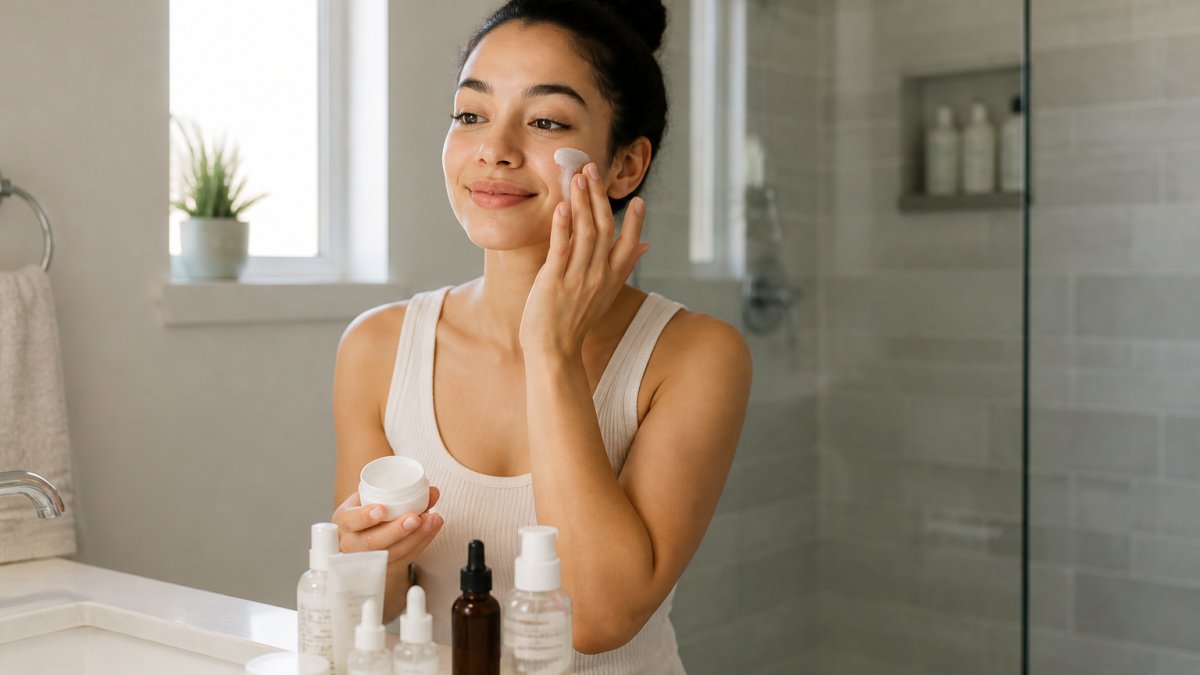
A complete preventive routine needs three products, not ten: a gentle cleanser, a moisturizer, and a broad-spectrum sunscreen. Add one active when you have a specific concern.
Cleanser, Moisturizer, and the Skin Barrier
The skin barrier is the outer layer that holds moisture in and irritants out. Over-cleansing and harsh scrubs damage it, which shows up as tightness, redness, and breakouts. Use a gentle cleanser morning and night, and moisturize while skin is still slightly damp.
Vitamin C and Antioxidants
Vitamin C is a well-supported antioxidant for daytime use, and it pairs naturally with sunscreen. It's a reasonable first active for most people in their 20s. Introduce it in the morning, start a few times a week, and give it several weeks before judging results.
Retinol Anti-Wrinkle Moisturizer →
Retinol in Your 20s: Who Benefits, Who Should Wait
Retinol is the most evidence-backed anti-aging active available without a prescription, and it's also the one people misuse most. It helps with fine lines, texture, and dark spots, but it takes months of consistent use and it can irritate skin badly if rushed. Our take: worth it in your late 20s if you have a specific concern and a stable routine, and not worth it if your skin is currently reactive or you're still figuring out the basics.
Patch Testing and Safe Introduction of Actives
- Apply a small amount to your inner forearm and wait 48 hours
- Start with two nights per week, never nightly
- Apply to dry skin, then moisturize over it
- Pause if you see stinging, peeling, or persistent redness
- Add only one new active at a time, spaced weeks apart
If you want a gentler entry point, a formula built around bakuchiol alongside retinol, like our Bakuchiol Retinol Anti-Aging Serum ($32.99), is designed for daily use with less irritation risk. For a simpler first step, our Retinol Anti-Wrinkle Moisturizer ($34.93) combines retinol with hydration in one product, which suits people who won't reliably layer a separate serum.


Apply retinol to completely dry skin and wait a few minutes after cleansing. Damp skin increases penetration, which is exactly what you don't want in your first month.
Prevention vs. Buying Anti-Aging Products: A Cost and Value Comparison
Prevention-focused care beats product accumulation on both cost and results. The comparison below uses our own routine pricing so you can see the trade-off in real dollars, not vague ranges.
| Approach | What's included | Monthly cost | Value verdict |
|---|---|---|---|
| Prevention-first | Cleanser, moisturizer, SPF | Under $30 | Highest return, lowest risk |
| Prevention plus one active | Above plus vitamin C or retinol | $30-$60 | Worth it with a specific concern |
| Product stacking | Multiple serums and treatments | $80-$150 | Rarely justified in your 20s |
If you're currently spending $80 to $100 a month, moving to a three-product routine plus one active usually cuts that in half while improving consistency, which matters more than product count.
Different Needs by Skin Type, Tone, and Concern
There is no universal routine, and the differences matter more than most guides admit. Acne-prone skin needs non-comedogenic formulas and a slow hand with occlusive creams. Dry skin benefits from richer moisturizers and gentler cleansing. Sensitive skin should introduce actives one at a time and patch test every new product.
Skin tone changes the picture too. Deeper skin tones are more prone to hyperpigmentation after inflammation, so aggressive exfoliation and picking at breakouts can leave lasting dark spots. If you're pregnant, breastfeeding, or using prescription skincare, talk to your doctor before starting retinoids.
For anyone wanting a richer overnight option, our Night Cream Face Moisturizer with Retinol, Collagen, Niacinamide 10% ($57.99) pairs retinol with 4D hyaluronic acid for hydration. Our GlowLift Gold Collagen Anti-Wrinkle Cream Set ($69.99) suits someone ready to commit to a fuller routine, and the Eyephalt Miracle Repair Cream ($72.50) targets the under-eye area specifically.

Conclusion
The hard part isn't finding products. It's resisting the pressure to buy more than your skin needs and sticking with the boring basics long enough to matter. Start with sunscreen, a gentle cleanser, and a moisturizer, add one active only when you have a reason, and give it months rather than weeks. Gotcha Girl Cosmetics stocks affordable, cruelty-free options for exactly that approach, from Korean-inspired hydration to gentle retinol formulas, and we're happy to help you build a routine you'll keep.
Frequently Asked Questions
Is 25 too early for retinol?
It's not too early, but it's not mandatory either. Retinol in your 20s makes the most sense if you're already seeing fine lines or texture changes, or if you want to get ahead of collagen decline, which starts gradually in the mid-20s. Start with a low-strength formula two nights a week and build up. If your skin is sensitive or acne-prone, a gentler option like a bakuchiol and retinol serum can reduce irritation while you adjust. Sunscreen during the day is non-negotiable once you start.
At what age should I start anti-aging skincare?
There's no single age, but most dermatologists point to the mid-20s as a reasonable time to start prevention-focused care. The key word is prevention: daily broad-spectrum sunscreen, a gentle cleanser, and a moisturizer that supports your skin barrier do more for long-term skin health than any single anti-aging product. Actives like retinol or vitamin C can be added when you have a specific concern, like early fine lines or dark spots, rather than on a birthday deadline.
Does sunscreen really prevent signs of aging?
Yes. UV exposure is a major driver of premature skin aging, including fine lines, wrinkles, and hyperpigmentation. Daily broad-spectrum sunscreen with SPF 30 or higher is the most reliable anti-aging step you can take in your 20s, and it costs far less than a shelf of serums. Reapply during long sun exposure, and skip tanning beds entirely. If you want one product that earns its place in your routine, sunscreen is it.
Is 27 too late to start a skincare routine?
Not at all. Skin aging is cumulative, so starting at 27 still puts you ahead of starting at 35. Begin with the basics: a gentle cleanser, a moisturizer suited to your skin type, and daily sunscreen. From there, add vitamin C in the morning for antioxidant support and consider retinol at night if fine lines or texture are a concern. Consistency over months matters more than the number of products you own.
What skincare products are actually worth using in your 20s?
The short list: broad-spectrum sunscreen, a gentle cleanser, a moisturizer, and optionally vitamin C and a retinoid. Everything else is a bonus. If you want to add a targeted anti-aging product without overcomplicating things, a retinol moisturizer or a gentle retinol and bakuchiol serum covers fine lines and texture in one step. Patch test new actives, introduce one at a time, and give each product eight to twelve weeks before judging results.
Worth it in your 20s? Yes, if prevention leads and products follow. Shop Gotcha Girl Cosmetics to build a simple, sustainable routine that protects your skin now and pays off later.